Tier 1 · Foundation · Module 1.1
Buyers, sellers, order books, price discovery
Learn what a market is, how buyers and sellers form price, how the order book works, and why the spread is a real cost on every trade.
Lesson 1 of 3 · 8 min read
Every chart you will ever read is a record of one thing: buyers and sellers agreeing on a price. Before you learn candlesticks, indicators, or strategies, you need a clear picture of how that agreement happens — because it explains why price moves, why you pay a spread, and why your order doesn't always fill where you expected.
What you'll learn
- What a market is, and the difference between exchange and over-the-counter (OTC) markets
- How price discovery actually works — and why "more buyers than sellers" is only half the story
- How to read an order book: bids, asks, depth, and the spread
- Why a market order can fill at several prices, and how to calculate your average fill
- Why the spread is a cost you pay on every single trade
1. What is a market?
A market is any place — physical or digital — where buyers and sellers meet to exchange something for a price.
- A vegetable market: farmers sell, shoppers buy.
- The stock market: investors buy and sell shares of companies.
- The forex market: currencies such as USD, EUR, and JPY are exchanged.
- Commodity markets: gold, oil, and wheat change hands.
A market needs two sides: someone willing to sell and someone willing to buy. No counterparty, no trade.

Exchange vs over-the-counter (OTC)
Not all markets are organised the same way, and it matters for what you can see as a trader.
| Market type | How it works | Examples | What you see |
|---|---|---|---|
| Exchange | One central venue matches all buy and sell orders | Stocks (NYSE, Nasdaq), futures (CME) | A shared order book and official volume |
| OTC | Trades happen between dealers, banks, and brokers — no single central venue | Spot forex, spot gold (XAU/USD) at most retail brokers | Your broker's quote, not the whole market |
2. Price discovery: how price is formed
- A buyer wants to pay as little as possible.
- A seller wants to receive as much as possible.
- A trade happens only when both agree on a price.
The ongoing process of buyers and sellers negotiating — and the price moving until they agree — is called price discovery.
Worked example
(Prices are illustrative.)
- A seller is asking $1,905 for 1 oz of gold.
- A buyer is only bidding $1,900.
- Nothing trades. There is a $5 gap between them.
- News hits that makes gold more attractive. The buyer decides they must own gold now and raises their bid to $1,905.
- The trade happens at $1,905 — and that becomes the new last traded price.
Notice what moved price: the side that was more urgent gave way. The buyer crossed the gap to meet the seller.
The more precise rule
You will often hear "more buyers than sellers pushes price up." Strictly, every trade has exactly one buyer and one seller, so the numbers are always equal. What actually moves price is urgency:
- When buyers are more aggressive — willing to pay the seller's asking price immediately — price moves up.
- When sellers are more aggressive — willing to accept the buyer's bid immediately — price moves down.
3. The order book: where buyers and sellers line up
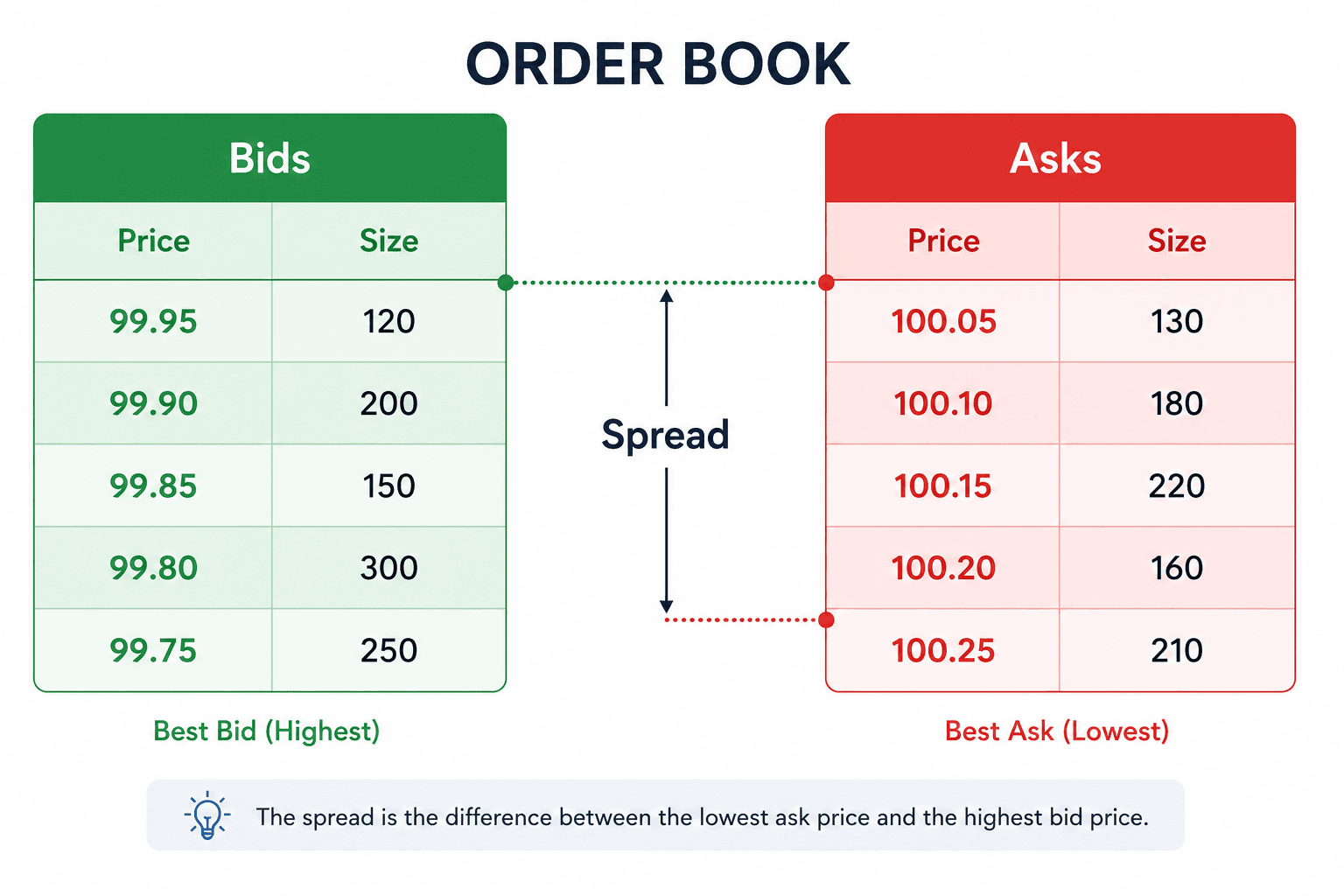
An order book is a live list of orders waiting to be filled.
- Bids — buy orders, and the prices buyers are willing to pay.
- Asks (or offers) — sell orders, and the prices sellers are willing to accept.
The highest bid and the lowest ask are called the best bid and best ask. The gap between them is the spread.
| Side | Meaning | Example |
|---|---|---|
| Best bid | Highest price a buyer will currently pay | $1,900.00 |
| Best ask | Lowest price a seller will currently accept | $1,902.00 |
| Spread | Best ask − best bid | $2.00 |
Depth: how much is waiting at each price
Each price level also has a size — how much is available there. This is called market depth.
| Asks (sellers) | Size |
|---|---|
| $1,902.50 | 4 lots |
| $1,902.20 | 2 lots |
| $1,902.00 (best ask) | 1 lot |
| Bids (buyers) | Size |
|---|---|
| $1,900.00 (best bid) | 3 lots |
| $1,899.70 | 5 lots |
| $1,899.40 | 2 lots |
Worked example: "walking the book"
You place a market order to buy 3 lots. A market order says "fill me now at the best prices available." Here's what happens:
- 1 lot fills at $1,902.00 — that level is now empty.
- The next 2 lots fill at $1,902.20.
Your average fill price = (1 × 1,902.00 + 2 × 1,902.20) ÷ 3 = $1,902.13
Your order "walked" up the book because the best level didn't have enough size. The difference between the price you saw ($1,902.00) and the price you got ($1,902.13) is a form of slippage — you'll study it properly in Module 1.3.
4. The spread is a cost on every trade
When you buy, you pay the ask. When you sell, you receive the bid. So if you bought and immediately sold, you would lose the spread.
(Illustrative figures. At many brokers, 1 standard lot of gold = 100 oz — always check your broker's contract specifications.)
- Buy 1 lot of gold at the ask: $1,902.00
- Sell immediately at the bid: $1,900.00
- Loss: $2.00 × 100 oz = $200 — before price has moved at all
This means every trade starts slightly negative. Your trade has to move in your favour by at least the spread just to break even.
Common beginner mistakes
- Ignoring the spread. Judging a trade only by the chart price, not the price you actually paid.
- Assuming the chart price is the fill price. Most charts plot the bid. Your buy order fills at the ask.
- Using market orders in thin conditions. Walking the book during quiet hours or around news can cost more than expected.
- Believing price moves "for no reason." Price moves when one side becomes more urgent — there is always an order flow reason, even if you can't see it.
Key terms
| Term | Meaning |
|---|---|
| Price discovery | The process by which buyers and sellers arrive at a traded price |
| Bid | The price a buyer is willing to pay |
| Ask / offer | The price a seller is willing to accept |
| Spread | Best ask minus best bid — a cost on every trade |
| Order book | Live list of waiting buy and sell orders at each price |
| Market depth | The size available at each price level |
| Market order | An order to fill immediately at the best available price |
| Last traded price | The price of the most recent completed trade |
Practice
On your demo trading platform:
- Open the quote for XAU/USD and EUR/USD. Write down the bid, the ask, and the spread for each.
- If your platform has Depth of Market (DOM), open it and identify the best bid, best ask, and the size at each.
- Check your chart settings: is the chart plotting the bid, the ask, or both? (In MT5, you can enable the Ask price line in chart properties.)
- Record the spread again at a different time of day. Did it change? Keep this note — you'll use it in the sessions lesson.
Quick recap
- A market needs a buyer and a seller. Exchanges centralise orders; OTC markets such as spot forex don't.
- Price moves when one side is more urgent and crosses the spread to get filled.
- The order book shows bids and asks at each price, with a size at each level (depth).
- Large market orders can walk the book and fill at a worse average price.
- You buy at the ask and sell at the bid, so the spread is a cost on every trade.
Educational content only — not financial advice. Trading involves substantial risk of loss. Practise on a demo account before risking real money.