Tier 1 · Foundation · Module 1.1
Market sessions and liquidity cycles
Learn the Sydney, Tokyo, London, and New York sessions, when liquidity peaks and dries up, and how to match your trading hours to your market.
Lesson 3 of 3 · 7 min read
The same market can behave like two different instruments depending on the hour. EUR/USD at 3 a.m. London time and EUR/USD at 2 p.m. London time have different spreads, different speeds, and different kinds of moves. Knowing when a market is active is one of the simplest edges available to a new trader — and one of the most ignored.
What you'll learn
- The four major trading sessions and when they overlap
- The difference between liquidity and volatility — and why you want both
- The daily and weekly liquidity cycle, including the risky low-liquidity windows
- How different markets (forex, gold, stocks, crypto) keep different hours
- How to choose trading hours that fit both your market and your life
1. The four major sessions
Forex trades 24 hours a day, five days a week. Activity follows business hours around the globe, handing off from one financial centre to the next.
| Session | Approx. hours (GMT, standard time) | Character |
|---|---|---|
| Sydney | 22:00 – 07:00 | Opens the trading week; generally the quietest |
| Tokyo | 00:00 – 09:00 | More activity in JPY, AUD, and NZD pairs |
| London | 08:00 – 17:00 | The largest forex centre; volatility often picks up at the open |
| New York | 13:00 – 22:00 | Major US data releases; heavy activity while London is still open |
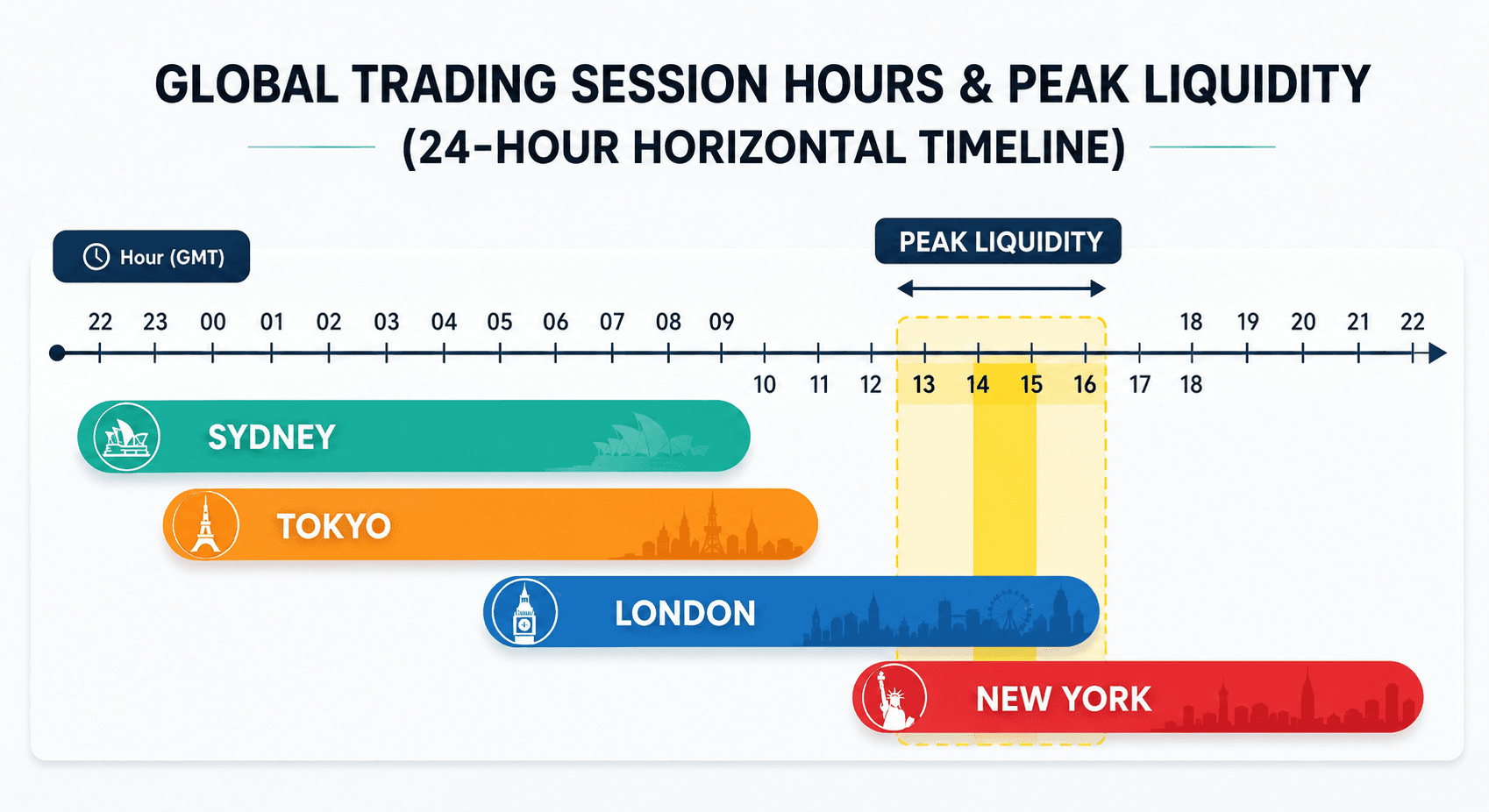
Notes on the diagram
- The Sydney session (22:00–07:00 GMT) starts the evening before the 00:00 mark, so on a 24-hour strip its bar only shows the tail end (00:00–07:00).
- These hours are approximations. They shift by about an hour when daylight saving time starts or ends in each region — and different regions switch on different dates. Treat them as a guide, and check your platform's server time.
2. Session overlaps: where liquidity peaks
The busiest periods happen when two major centres are open at the same time.
- London–New York overlap (≈ 13:00–17:00 GMT): typically the most liquid window of the day for major currency pairs and gold. Spreads tend to be tightest and big moves most common.
- Tokyo–London overlap (≈ 08:00–09:00 GMT): short, but often the start of the day's European activity.
Scheduled US economic releases — such as jobs and inflation data — are commonly published at 8:30 a.m. New York time, which falls inside the London–New York overlap. That combination of deep liquidity and fresh information is why so many of the day's largest moves happen here.
3. Liquidity vs volatility
These two words are often confused.
| Liquidity | Volatility | |
|---|---|---|
| Meaning | How easily you can trade size without moving price | How much and how fast price moves |
| High means | Tight spreads, clean fills, little slippage | Large ranges, bigger opportunities — and bigger risk |
| Low means | Wide spreads, jumpy prices, slippage | Small ranges; price may barely move |
The best conditions for most traders are high liquidity with enough volatility to reach a target. The worst are low liquidity with a sudden burst of volatility — for example, a surprise headline at 3 a.m. — where spreads widen and stops can fill well away from where they were placed.
4. The daily and weekly liquidity cycle
Liquidity isn't just about sessions. It follows predictable daily and weekly rhythms.
Daily
- Daily rollover (around 17:00 New York time): many brokers roll positions to the next trading day. Spreads commonly widen for several minutes around this time. Avoid opening new trades in this window.
- Late New York to early Asia: often the thinnest part of the day for most major pairs.
Weekly
- Monday open (Sydney): price can gap from Friday's close if news broke over the weekend. Spreads are often wide for the first hour.
- Friday afternoon (New York): liquidity fades as traders close positions ahead of the weekend.
Seasonal
- Bank holidays in the UK or US thin out the market even if other centres are open.
- Late December and much of August are traditionally quieter as many professionals are away.
5. Different markets, different clocks
| Market | Trading hours | Most active |
|---|---|---|
| Major forex pairs | 24 hours, Monday–Friday | London session and the London–New York overlap |
| Gold (XAU/USD) | Nearly 24 hours, Monday–Friday (short daily break at many brokers) | London and New York sessions |
| Stocks | Exchange hours only (e.g. US regular session 9:30 a.m.–4:00 p.m. New York time) | The first and last hour of the session |
| Crypto | 24 hours, 7 days a week | Liquidity often thinner at weekends |
Worked example: same trade, different hour
(Illustrative spreads — yours will depend on your broker.)
You want to buy 1 lot of EUR/USD with a 15-pip stop.
| Time (GMT) | Typical spread | Spread as % of your stop |
|---|---|---|
| 14:00 (London–NY overlap) | 0.2 pips | ~1% |
| 21:55 (around daily rollover) | 3.0 pips | ~20% |
The setup is identical, but at rollover the spread alone eats a fifth of your risk before price moves at all — and a spike could stop you out on spread widening alone.
Common beginner mistakes
- Trading only when it's convenient, not when the market is active — then blaming the strategy for choppy, low-quality moves.
- Opening trades around daily rollover, when spreads can be many times their normal size.
- Holding tight stops over the weekend without allowing for a Monday gap.
- Forgetting daylight saving changes, and suddenly trading an hour early or late for a few weeks each year.
Key terms
| Term | Meaning |
|---|---|
| Trading session | The business hours of a major financial centre (Sydney, Tokyo, London, New York) |
| Session overlap | A period when two major centres are open at once |
| Liquidity | How easily you can trade without moving price |
| Volatility | How much and how quickly price moves |
| Rollover | The daily point (≈ 17:00 New York time) when positions roll to the next trading day |
| Gap | A jump in price between one close and the next open, with no trading in between |
Practice
- Convert the session table into your local time zone, including daylight saving adjustments, and save it.
- On your demo platform, record the EUR/USD and XAU/USD spreads at three times: during the London–New York overlap, during the Asian session, and within 10 minutes of daily rollover.
- On an H1 chart, look at the last five trading days. Mark where the largest hourly candles happened. Which session were they in?
- Write down the two-hour window each day when you can realistically focus on trading. Does it line up with an active session for the market you want to trade?
Quick recap
- Forex trades 24/5, passing from Sydney to Tokyo to London to New York.
- The London–New York overlap is typically the most liquid window for major pairs and gold.
- Liquidity (ease of trading) and volatility (size of moves) are different — aim for high liquidity with enough movement.
- Spreads widen around daily rollover, at the weekly open, over holidays, and around news.
- Match your trading hours to the market you trade — it's one of the easiest edges you can give yourself.
Next up: Module 1.2 — Reading a Chart.
Educational content only — not financial advice. Trading involves substantial risk of loss. Practise on a demo account before risking real money.